


If aptly written and described
yet no one’s maimed—too bad—or died
One hopes the reader of calamity
Will grant the author partial amity
When details run precise and gross
and medical Greek is swapped for prose
Still, in the details of a story
some may find the telling gory
Some don’t like precise descriptions
blood and guts cause some conniptions
If such are you, then read no further
find a book! Enjoy a Werther!
But spare us your indignant foam
and let the rest enjoy this tome!
I was stacking reclaimed white oak beams on a hot June day in my small garage shop in a boring neighborhood in Covington, Georgia. I had just brought a trailer full of wood home for a custom timber-framed dining room table I was commissioned to build. The edges and corners of the beams weren’t even crisp and square like newly sawn wood, but old and worn to a seemingly soft and pleasing roundover. The beams were small too—3x4, 4x6, 2x8—all probably from five to nine feet long. With my left hand supporting my weight as I leaned over the stack, I picked up a middle beam with my right hand to get a good look at it. Without any warning or to-do, it slipped out of my hand and came down like a shear on the ring finger of my left hand which was on the edge of the adjacent beam. With a simultaneous jerk I pulled my left hand out of the way, but still felt an awful, stupid pain in my ring finger and I knew immediately it wasn’t something I could kiss to make better. The dull corner of the heavy beam had entered into my finger on the top behind the nail bed and when I jerked, it cut the flesh around both sides of the bone and pulled the last inch and the whole nail off the finger bone and it was hanging off the bottom by the skin of the pad. The bleeding had now begun.

With the purposeful walk of “I’m an adult and I don’t panic very often—but this is important…” I came through the garage door into the house calling to my wife: “Grace! I need some help!”
Now, I have basically been helped with injuries and illness by two women in my life: My mother and my wife. (Also, a third sweet missionary lady in Mexico who stuck a needle in my backside to stop my spasms after two days of throwing up—but that is another story for another time.) While I normally have no doubts concerning their affection for me, I have noticed that they have each and all inherited a strongly overdeveloped sense of cruelty when it comes to washing out wounds. While I’m leaning over the sink grunting and groaning by turns and biting my shirt collar to keep from yelping, my mostly-German wife washed out the ribbons of my crushed and degloved finger with a standard of cleanliness the Dutch would be proud of.
Never having been one to slink to a doctor unless it is a real emergency concerning anatomy I know nothing about or have never imagined, we looked at the mangled finger, got down to business, and began the long work of putting the pieces back the way they are supposed to be. The fingernail was disturbingly shattered into four parts like a choral piece by Charles Ives, and the sides were split into multiple cuts curving around to almost connect in the pad. At one point Grace was trying to bandage the nail bed on top of the skin, and I had to explain wryly, “that part slides under—that is, if you ever want me to have a fingernail again.” After an hour or so, we got everything put together so it looked about right despite the swelling, then Grace began cutting tiny butterfly bandages out of medical tape. It took six butterflies to hold everything together on the last inch of my left ring finger. I’ve noticed no one ever calls them “moth bandages”. Perhaps it is a matter of bedside manner. I suppose moth bandages would disintegrate into dust when touched, and no-one gets “moths” when they are happily excited or falling in love, so it has never become a thing. Makes sense, but still, it makes you wonder who thought of it first.
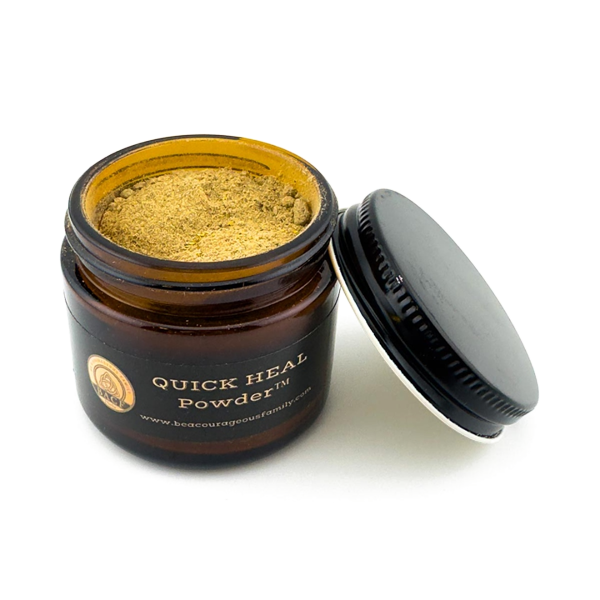
Having studied herbal medicine rather extensively, my wife prepared a mixture of powdered herbs including chickweed and coated my finger all over before putting the bandage on. For whatever reason, the chickweed mixture began to cause quite a lot of pain, so I persuaded her to wash it off and try something different. She took out the chickweed, went back to her books and notes, and the result she came up with, became our famous QuickHeal Powder™ product. With the butterfly bandages in place and before applying the gauze or the outer bandage, Grace mixed the fine herbal powder with tea tree oil until it became a thick paste, coated my wound liberally with it, wrapped it in gauze and finally applied a bandage. For the first time in my life, the smashed finger stopped throbbing and never began again. I was astonished. Finger wounds always throb—especially crushed ones!
This all happened in the afternoon. Later that evening we unwrapped the bandage, rinsed away the herbal powder and tea tree oil and looked at the wounds. The swelling had diminished considerably due to the anti-inflammatory properties of the herbs, but to my private chagrin, my finger was not as handsome of a shape as it used to be—in fact, it had a noticeable twist and sideways bend to it, like when a tattoo artist is holding your bicep tightly while they draw, and upon release, the flesh pops back into anatomical position only to reveal a sword that looks like a walking stick from New Hampshire!
Welp. That was my finger now. As a classical pianist I knew that Bach had missed the bottom three steps with a thud on his way out of my future, but I was simultaneously confronted with the alarming possibility that I might now be able to play the fudge-sounding part of Liszt’s Hungarian Rhapsody II with only one finger—the sideways one. My sensibilities were beginning to be insulted. Enough is enough. It was now or never. “Grace, take the bandages off and start over. It’s crooked.”
So, she began. It was 10 pm and using a scalpel, industrial grade CA glue and chemical activator from my shop and long thin butterfly bandage strips, she began the surgical reconstruction of my finger by opening the wounds and rearranging them back into anatomical position. By 10:30 pm both glue and activator had gotten out of hand—or rather into hand, and my wife and I had only one remaining finger each that was not superglued to my injury in some way.

All the children were in bed. All of them were also too young to be deeply trusted with a scalpel or a jug of acetone. Furthermore, the idea of dipping my crushed hand into a bowl of acetone to dissolve the CA glue was about as welcome of an idea as re-living the night my Dad tried to siphon gasoline out of our van with his mouth. It occurred to me later that on a date, the idea of my cute wife becoming accidently superglued to me in the evening might’ve been romantic in a humorous and slightly embarrassing way. Grace must have had similar thoughts because she started to giggle. I’m not a doctor, but I distinctly remember the command against giggling for surgeons is—or ought to be—embedded prominently in the Hippocratic Oath.
I’ve always considered myself to be of a romantic disposition, but on this evening, plunged into these circumstances; it would’ve been more accurate to describe me as an almost-frantic-romantic. I began to sweat. Grace continued giggling. The man who was our neighbor to the south was ill and indisposed to any kind of superglued couple rescue operation, and our neighbor lady to the north was 92 years old and probably in bed, and probably not to be trusted with the kind of story that was writing itself, so it was down to our two free fingers. People say a husband and wife ought to stick together. Been there. Done that. Please clarify the proverb. When you only have two fingers left, and they each belong to different people, you begin to appreciate the other nine you’ve foolishly discarded.

Between painful pulling and some very slow and careful use of a scalpel and many half suppressed laughing whispers of “this is very bad!” and “shouldn’t we call the lady next door?” and “how would we even dial her number?” more giggling on the part of my wife, and thoughts of “this only happens in Reader’s Digest” going through my head, we finally freed ourselves, finished bandaging my finger and went to bed.
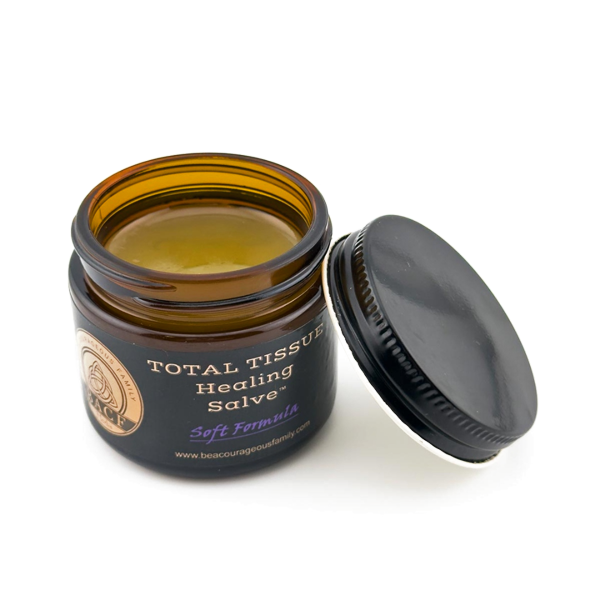
By the next day I could work in the shop again if I wore a soft aluminum splint on my finger over the thin bandage—that is how effective the pain-killing element of the powder and tea tree oil mixture is. Within a couple of days the skin was closed up and then we began applying our Total Tissue Healing Salve™ to speed up the healing and to continue controlling the pain. While the nail took a few months to heal, the rest of the finger healed quickly and beautifully, with nearly perfect nerves and eventually even a healthy fingernail. We learned a lot from that injury, and now, nearly ten years later: I still play Bach, have never learned any of the Hungarian Rhapsodies, and I have once again proved the old adage: “tragedy plus time equals comedy.”
True Story
Written by Luke

(AI was NOT used to write any of the text in this article)